Flash sale
SAVE 10%

SHARE THIS ARTICLE




Lorem ipsum dolor sit amet consectetur. Lacus praesent faucibus facilisis nunc pellentesque nibh scelerisque purus at. Enim integer vitae et fermentum. Est donec est convallis auctor dapibus.

Workforce planning is the strategic process of ensuring an organization has the right people, with the right skills, in the right roles, at the right time in order to meet current and future workforce needs of a business. It involves understanding business needs and goals, translating those needs into future workforce requirements, and taking necessary actions to ensure an organization has the right human resources to meet those business needs.
This may seem like a simple process, but many organizations struggle with workforce planning. According to Gartner, 86% of HR leaders have not implemented strategic workforce planning despite it being a top priority.
Without effective workforce planning, they often end up in one of two states: having too many people or too few people, resulting in rushed hiring, expensive contracts, overworked staff, or lost revenue & business growth opportunities.
In this post, we will understand how to do effective workforce planning, common challenges in workforce planning, and solutions to those challenges.
Workforce planning is the process of analyzing your current workforce, forecasting future workforce needs, and taking action to ensure you have the right number of people with the right skills to meet business goals. It connects business strategy with workforce requirements and people’s decisions.
Workforce planning helps organizations in cost optimization, improving work quality and productivity, better workload balance, building organizational resilience to change, and effective talent risk management.
Without the effective workforce planning, businesses either end up having too many people or too few people.
When a company has more employees than required, it leads to underutilization of the workforce and increased operational expenses.
Similarly, when a company doesn't have enough employees, it leads to overworked employees, increased employee burnout, poor quality work, and lost business opportunities.
Organizations need workforce planning because their workforce needs change as the business changes. They win and lose clients, launch products, enter new markets, adopt new technologies, experience employee turnover, and change their business strategies.
If you only react when workforce demand arrives, you are already late. You pay for it through rushed hiring, expensive contractors, burned-out staff, or lost revenue.
Also, when you hire a specialist reactively, it usually takes two to four months for a hire to become fully productive. Business decisions can change within weeks, but the workforce cannot.
The purpose of workforce planning is to make sure business have the workforce ready to accommodate the change.
Let’s understand it by an example.
Imagine you run a BPO company with 500 employees.
Today, you have enough employees to handle your current client contracts. But you know that:
One major client may add 100 seats next quarter.
30 employees may leave this year.
You may need people with AI and automation skills.
Some existing employees may have too little work.
Other teams may already be overloaded.
You cannot wait until the new contract starts and then say, “We need 100 people. Let's hire them.”
You need to think ahead.
That's workforce planning.
Here are the five common reasons businesses need workforce planning:
When a company grows, it often needs more employees or new skills to handle increased demand. A new client, product launch, market expansion, or increase in sales can all create additional workforce requirements.
Workforce planning helps organizations determine how many people they will need, which roles they need to fill, and when those employees will be required.
Employees leave, retire, change roles, or move between departments. High employee turnover can create workforce gaps, particularly in roles that are difficult to replace.
Workforce planning helps organizations anticipate these changes and prepare for them instead of waiting until critical positions become vacant.
The skills a business needs can change as technology, customer expectations, and business models evolve. For example, a technology company may need more employees with AI, cloud, or data skills as it expands its technology capabilities.
Workforce planning helps identify these skill gaps and determine whether the organization should hire new talent, train existing employees, or redeploy people into new roles.
New projects, automation, restructuring, seasonal demand, and changes in workload can all affect how much workforce capacity an organization needs.
A company may discover that one team is overloaded while another has excess capacity.
Instead of automatically hiring more people, workforce planning can help determine whether work should be redistributed, employees moved between teams, or certain tasks automated.
Labor is a major operating cost for many organizations, so businesses need to make sure their workforce capacity is aligned with actual business demand.
Workforce planning can help organizations identify areas where they may have excess staffing, low employee utilization, excessive overtime, or workforce costs that are not aligned with business requirements.
“Read more: 9 Key Factors to Track Employee Performance
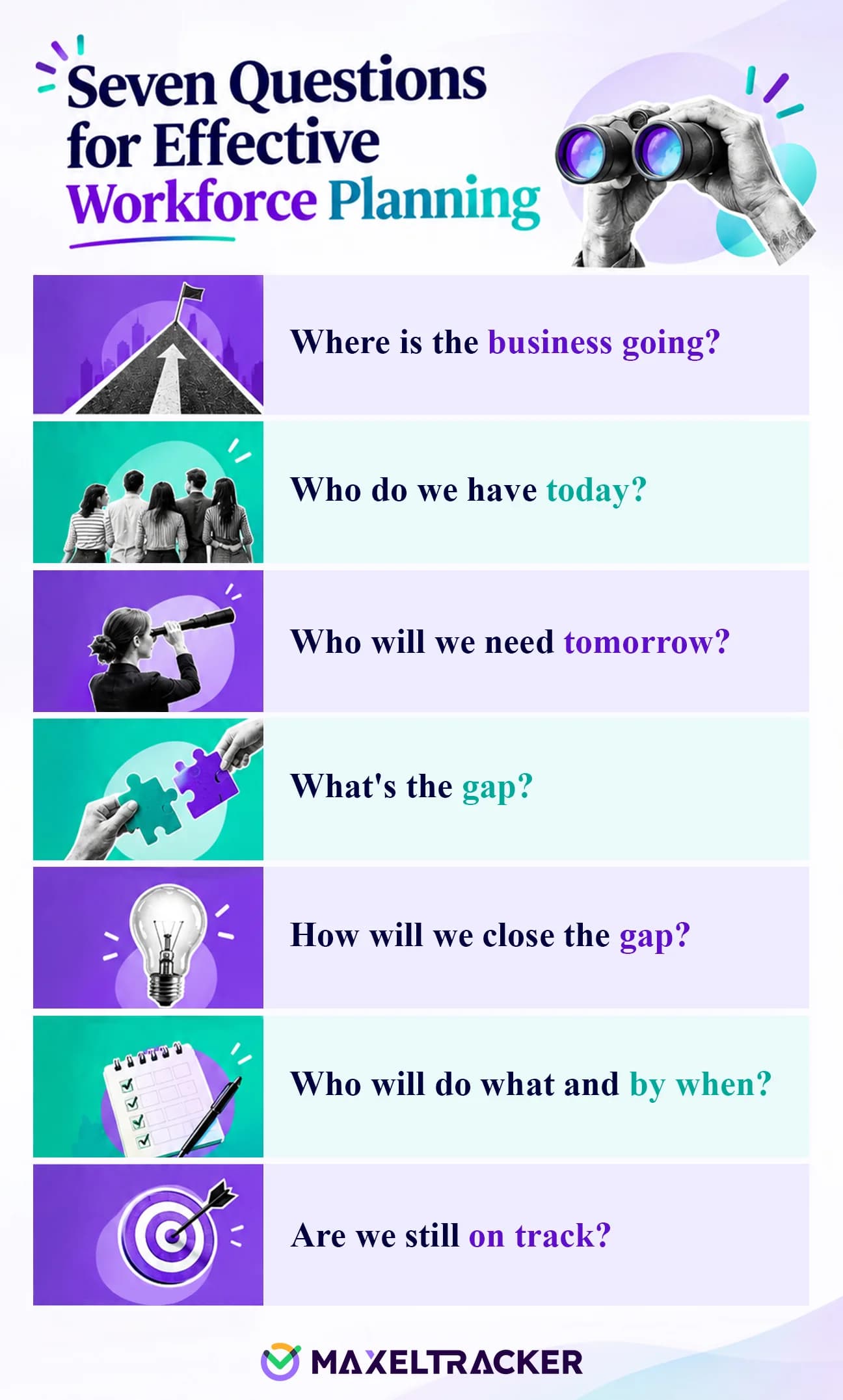
Workforce planning can be broken down into seven practical steps: understand business goals, analyze the current workforce, forecast future workforce needs, identify gaps, develop an action plan, implement the plan, and monitor & adjust. Let's look at each step.
Clearly define what the organization wants to achieve. Is the company planning to grow, enter a new market, launch a product, acquire new customers, reduce costs, or adopt new technology?
Translate the goal into workforce requirements and implications so you know what talent you must have to deliver.
The goal of this step is to understand where the business is going and what that could mean for its workforce.
Once you understand the business goals, look at the workforce you already have. To do so, analyze factors such as:
Total headcount
Departments and teams
Roles and job functions
Employee skills and experience
Workforce locations
Employee turnover
Absenteeism
Current workload and capacity
Workforce costs
This gives the organization a clear picture of its current workforce and skills it has today.
The next step is to determine what the organization will need in the future. Consider factors such as expected business growth, upcoming projects, customer demand, seasonal changes, employee turnover, productivity, and technology adoption.
For example, an organization may determine that its future plans will require 130 developers, 25 QA engineers, and 15 project managers, compared with 100, 20, and 10 respectively today.
Compare the current workforce with the future workforce requirements to identify gaps in headcount, skills, capacity, and location, and note surpluses that can be redeployed.
For example:
Role | Current Workforce | Future Requirement | Gap |
Developers | 100 | 130 | 30 |
QA Engineers | 20 | 25 | 5 |
Project Managers | 10 | 15 | 5 |
Customer Support | 30 | 40 | 10 |
This comparison helps identify where the organization may face workforce shortages.
Workforce demand forecasting also considers which skills and capabilities will be required in addition to headcount. The gap can take different forms:
Headcount gap: Not enough employees are available.
Skills gap: Employees are available, but the required skills are missing.
Capacity gap: There are enough employees, but their available capacity isn't sufficient for the workload.
Location gap: The required talent exists, but not in the location where it is needed.
Once the gaps are identified, determine how to address them. Hiring is one option, but it isn't the only one. Organizations can also:
Buy: Hire employees with the required skills.
Build: Train and upskill existing employees.
Borrow: Outsource work when external resources make more sense. For example, temporary, specialized, or surge needs.
Automate: Automate tasks that don't require additional employees.
Redeploy employees from teams with excess capacity.
Choose the right mix of “buy, build, borrow, automate, and redeploy”.
For example, instead of hiring 30 additional developers, an organization might hire 20, train 5 existing employees, and redeploy another 5.
The objective is to find the most appropriate way to meet future workforce requirements.
The next step is to turn the strategy into an actionable plan. Execute the plan with clear governance (HR, finance, line leaders), communicate changes, and track progress against milestones and metrics.
The plan should define:
What needs to be done
How many employees or skills are required
When they are needed
Where they are needed
Who is responsible
What the expected cost will be
To create a working plan:
Set governance and cadence: Assign an accountable leader, define a monthly/quarterly review rhythm, and align with finance for budget control.
Define accountability: For each gap, define actions, owners, timelines, budgets, and success metrics to ensure accountability.
Track KPIs: Monitor metrics such as time-to-fill, internal fill rate, skill proficiency gains, attrition in critical roles, overtime/contractor spend, and plan vs. actual headcount/cost.
Recalibrate: When business drivers shift, rerun the demand model and update the action plan; keep scenarios live, not static.
Output: A dashboard and review routine that shows progress on actions and KPIs, plus updated forecasts and revised plans each cycle.
This creates a clear workforce roadmap that HR, managers, finance, and business leaders can work from.
Workforce planning doesn't end when the plan is implemented. Review regularly and recalibrate when business conditions, demand patterns, or attrition risks change.
For example, a company may win a major client, lose a contract, experience higher-than-expected employee turnover, or introduce new technology that changes its workforce requirements.
The workforce plan can then be adjusted as business requirements change.
In other words, workforce planning is a continuous cycle of assessing the current workforce, anticipating future needs, addressing gaps, and adjusting the plan as circumstances change.
“Read more: How to Improve Efficiency of Employees
Workforce planning helps in cost optimization, improving productivity & work quality, building organizational resilience, ensuring talent risk management, and enhancing employee experience.
Workforce planning reduces expensive emergency hiring and overstaffing by matching headcount to demand using forecasts of sales, projects, and seasonality. In addition to that, it identifies overstaffed and understaffed functions by correlating staffing levels to demand. This helps in targeted reductions in workforce to optimize cost.
Workforce planning can help organizations understand whether their available workforce capacity is being used effectively. It balances workloads across teams and time by aligning staffing levels to workload and matches the right skills in the right roles through skills-gap analysis and targeted development. This improves work quality and reduces rework.
Workforce planning enables organizations to pivot faster when markets, products, or regulations change by identifying emerging skills requirements and gaps early. This gives businesses more time to prepare for changes in technology and customer requirements.
Employee turnover can create unexpected workforce gaps, particularly when experienced employees or people with specialized skills leave. Workforce planning allows organizations to anticipate potential workforce losses and prepare replacement strategies in advance. It lowers the risk of critical-role vacancies and succession failures.
Workforce planning improves employee retention and engagement by preventing chronic over/under-staffing and supporting work–life balance through better shift/roster planning.
Workforce planning translates business strategy and growth plans into role, skill, and headcount requirements. It tests feasibility of a plan against current supply and hiring capacity to make sure growth plans are actually deliverable with available talent.
Workforce planning sounds straightforward: understand the current workforce, predict future needs, identify gaps, and create a plan. However, in practice, organizations often face challenges such as inaccurate workforce data, lack of visibility into workforce capacity, and skills gaps in the market that make workforce planning difficult.
Let’s understand the most common challenges and ways to address them.
Workforce planning depends heavily on accurate information about employees, roles, skills, workload, turnover, and workforce costs. If this information is outdated, incomplete, or spread across different systems, it becomes difficult to understand the organization's actual workforce situation.
Create a reliable and centralized source of workforce data. Regularly update employee skills, headcount, turnover, and workforce capacity information so that workforce decisions are based on current data.
Predicting future workforce requirements is challenging because business conditions can change. New projects may be delayed, customer demand can fluctuate, and business growth may not happen as expected.
Use multiple scenarios instead of relying on a single forecast. Organizations can develop plans for different situations, such as higher-than-expected growth, slower growth, or changes in customer demand. Review forecasts regularly and update them when business conditions change.
Headcount alone doesn't tell an organization how much work its workforce can actually handle. Two teams with the same number of employees may have very different workloads, utilization levels, and available capacity.
Look beyond headcount and analyze workload, utilization, overtime, available capacity, and how employees spend their working time. This can help organizations distinguish between a genuine staffing shortage and a problem that may be addressed by redistributing work or improving processes.
Workforce management software can help you only with workforce data. To get visibility into your workforce performance, employee productivity tracking platforms like MaxelTracker can help you provide visibility into workforce performance.
MaxelTracker integrates with project management software like Jira, ClickUp, and Redmine to provide you with accurate data of time spent on projects and tasks.
Learn more about MaxelTracker integrations!
Beginners plan for 6–12 months ahead and often at a high level without role, skill, and location detail. This results in workforce capability gaps being unaddressed.
Run parallel operational (0–12 months) and strategic (1–3+ years) workforce plans. Break forecasts down by role, skill, location, or granular metrics. Use scenarios to stress-test assumptions.
An organization may have enough employees but still lack the skills required for its future plans. This results in critical roles staying open for months and plans rely on hiring that the market can’t supply.
Maintain a clear view of existing employee skills and compare them with future requirements. Decide whether the gap should be addressed through hiring, training, upskilling, or redeployment. For hard-to-fill positions, organizations can also focus on internal mobility and developing employees.
Unexpected employee departures can disrupt workforce plans, particularly when experienced employees or people with specialized skills leave.
Use historical turnover data to identify workforce replacement requirements and pay particular attention to critical roles.
Workforce planning can become ineffective when HR develops workforce plans without a clear understanding of business priorities, or when business leaders make hiring decisions without considering the broader workforce strategy.
Make workforce planning a collaborative process involving HR, business leaders, finance, and department managers. HR can provide workforce and talent information, department managers understand operational requirements, finance can assess workforce costs, and business leaders provide the broader strategic direction.
Hiring focuses on who we should hire to meet the business need whereas workforce planning asks questions such as should we hire new people, train existing people, or automate specific operations to meet business needs.
Suppose a company discovers that it will need 50 additional software engineers next year.
There are several possible solutions:
Hire 30 engineers.
Train 10 existing employees.
Move 5 employees from another department.
Automate some work that would otherwise require 5 additional employees.
Hiring only focuses on hiring 50 software engineers whereas workforce planning considers all the possible solutions. Hiring is only a part of workforce planning.
Strategic workforce planning focuses on the organization's longer-term workforce capabilities, often looking several years ahead whereas operational workforce planning focuses on shorter-term workforce requirements, typically over the coming months to a year or so.
Strategic workforce planning asks questions such as: “What capabilities will we need to execute our business strategy, and should we build, buy, or develop them?” For example, a technology company may assess whether it needs to establish an AI engineering capability over the next few years.
On the other hand, operational workforce planning deals with specific positions, hiring timelines, workforce capacity, utilization, and budgets. For example: “We need four additional senior developers in Q1 to deliver our signed contracts.”
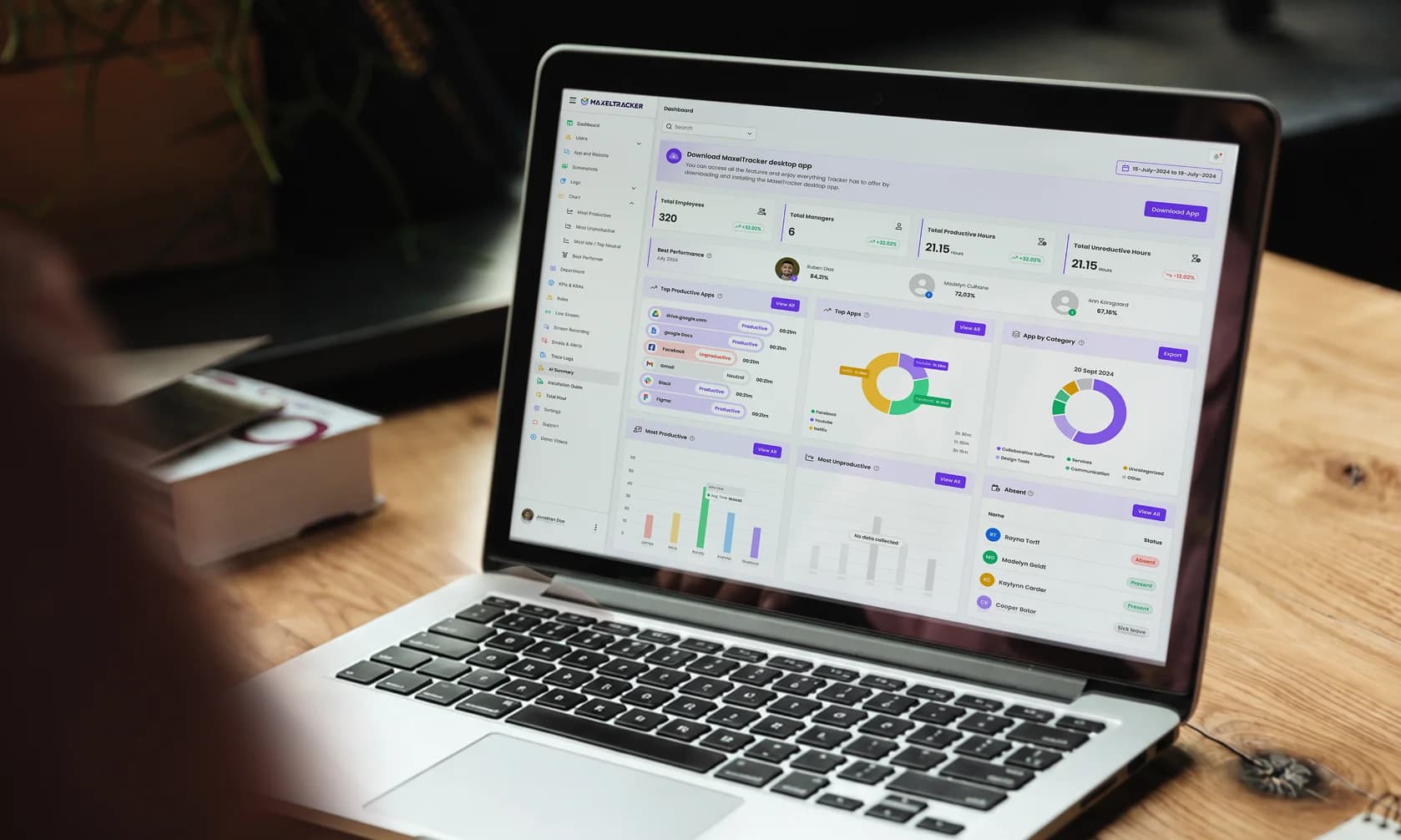
MaxelTracker is an employee productivity tracking platform that helps you track the time spent across work activities and generate insights to make workforce capacity related decisions. You can clearly visualize how employees are spending time, identify potential understaffing or overstaffing, and make realistic assumptions about the workforce based on reliable workforce data to make workforce decisions to meet business objectives.
Effective workforce planning is not a one-time activity. It is an ongoing process of monitoring, planning, and adjusting the workforce as business needs evolve.
By combining business strategy with reliable workforce data, skills analysis, capacity planning, and scenario planning, organizations can make better decisions about where people are needed, which skills are required, and how to prepare for future workforce needs.MaxelTracker helps organizations gather data and provide workforce performance insights.
6 Questions