Flash sale
SAVE 10%


Written by
Alan
Remote work rings a familiar bell, and it offers flexibility and global reach as well. But for CEOs, HR heads, and other important position holders across countries like USA, UK, Canada, or UAE, it is often the bringer of stress and uncertainty for many reasons. It exposes structural and cultural gaps in your company. The problems aren’t subtle either. If you’re asking “how do I know if my remote employee is working”, or looking for the best remote employee monitoring software, this blog will show you and what to do about it.
Remote teams usually lack spontaneous hallway chats. There are no quick whiteboard sessions or even “pop-over-the-desk” check-ins. This does away with innovation and slows down problem-solving.
Solution: Build structured touchpoints. Think about scheduling regular check-ins, virtual huddles, asynchronous updates, and cross-functional “open office hours” for everybody. Use a reliable remote team tracker, perhaps, to log progress and messages.
With no commute or office exit rituals, your employees do tend to find themselves working longer hours. Over time, yes, this drains productivity and morale at the same time.
Solution: Time to enforce structured work schedules right now. Encourage clear “clock-in / clock-out” norms for everyone, mandated breaks too, and dedicated workspace guidelines.
You don’t want this at all. Many remote workers eventually start feeling “remote”. This means that there is no casual social interaction, no on-site banter, no water-cooler catch-ups (or gossip if I might add). That erodes team cohesion.
Solution: You need to focus on intentionally building a culture. This should include virtual coffee breaks, informal check-ins, team-building sessions (fun and interactive), and cross-department meetups. Maintain community channels even if remote, and in the end, you will realise how much fun work has become.
Have you noticed how remote work removes the built-in structure of office hours? Many of your employees struggle with prioritizing tasks, tracking deadlines, or coordinating with team members, and this is natural if you don’t know how to fix it.
Solution: Use pre-defined workflows always. It is better to adopt project-management tools that can be integrated with remote team tracking software. Use time-tracking or milestone-based accountability, and of course, avoid the vague “work till you finish” mindset.
Without any physical oversight or supervision, many of your managers would end up worrying about so many things. Are people really working? Are critical deadlines being met? This shows that remote setups, at times, can erode clarity and control.
Solution: Use remote time tracking software with live screen monitoring feature, or maybe some other features that log their productive and unproductive hours efficiently. Make use of timestamps, tasks completed, and deliverables to understand their engagement and activity better. Review them based on output, not just “time logged.”
Now this is so obvious, isn’t it? Must’ve happened with you too, during the covid period. Remote work often happens in homes, and they are not built for 9-to-5 jobs. Household chores, kids, pets, or noisy environments (particularly neighbours) derail their productivity.
Solution: Encourage your employees to create a dedicated workspace within their home. You can use time-blocking for this. Also, it is always advised to communicate boundaries clearly (to household/family). Insert buffer times to enable deep focus, and this will definitely yield results.
Remote work depends heavily on a stable internet connection, reliable hardware and software combination, and a secure access to both. Any lag or outage kills their momentum.
Solution: You need to make sure that you provide them with or at least subsidize proper hardware and stable internet connections. Update tools and troubleshooting processes for them so that they don’t have any reasons (or excuses for missed deadlines). Offer tech support immediately wherever possible.
Bringing new team members on board remotely is such a tiring job, wouldn’t you agree? It is often redundant and feels like tossing someone into the deep end of any abyss. They miss out on your company’s informal culture, inside jokes, age-old references, spontaneous learning methods, and the mentoring bit takes too long.
Solution: You need to have a more structured remote onboarding program. Assigning mentors for this job is a wise decision. You can also set up a virtual “meet and greet” process. Do remember to document roles and workflows, and also schedule regular check-ins, especially during the early weeks.
Have you ever noticed how some of your high-performing remote employees who deliver strong results throughout the year often don’t get the same visibility as other people? Those other people are the ones who are physically present in the office. When leaders can’t see someone’s effort or impact daily, they subconsciously undervalue that person. Now this creates a skewed perception, and therefore, any forthcoming promotions, bonuses, or recognition become scarce for them, resulting in decreased morale and low performance, which is bad for employee retention.
Solution: Time tracking software has a reporting dashboard for more clarity on high performing remote teams. Share their accomplishments so that their remote work is “seen” by all. Remember to ask remote employees to self-report regularly.
Remote employees are often the ones to miss out on informal learning, mentorship programs, or on-the-job training opportunities that are so typical in offices. This is a real and tangible disadvantage and it stalls their career growth.
Solution: Establishing virtual mentorship programs open to all is a good idea. Apart from that, regular employee performance reviews, skill-up sessions, and discussions make up for the many shortcomings that come attached to a remote work set-up. Make growth and learning part of your remote work policy today.
Global teams across countries such as the USA, UK, Canada, India, Germany, Russia, UAE have overlapping work hours with other parts of the work, and this can cause a lot of problems and delays. Scheduling calls or synchronizing tasks becomes painful for everybody.
Solution: You need to rotate meeting times fairly for everyone involved. Your company relies more on asynchronous work, and you need to embrace that. Don’t be hesitant in using tracking tools to monitor progress across geographical zones; respect local hours and holidays as well.
Remote work does give us all more flexibility, but it also somehow instills the expectation of constant availability in our minds. People end up being available round the clock and overworking, leading to early burnout.
Solution: You need to set clear boundaries for every job role. You can use the same tracking tools to monitor actual hours worked by everyone. Avoid praising employees who appear to be “always online.” Reward output, not presence.
Without proper visibility, managers and team leads fear slack and that is very obvious. Employees feel pressure to “prove work” and don’t really feel connected to their jobs. They work to show and not to lead or build the company. That fractures trust.
Solution: Build work policies based on deliverables. The intelligent use of remote employee monitoring software enables you to share transparent data with all your teams. Communicate to them clearly what metrics matter.
Working in isolation is not healthy in the long run. This cuts them off from their peers, and over time, their social bonds weaken, engagement comes to an all-time low, and people feel disconnected.
Solution: Incorporating regular virtual social sessions and team huddles with light banter is a great idea. There can be informal check-ins, recognition programs, and fun opportunities for team bonding.
This is a big paradox of remote work. There are so many chat tools, windows, project-management apps, video-calls, documents, emails, and more. Switching between them is exhausting. What happens next? They start complaining of "tool overload."
Solution: Rationalize your tool stack because digital saturation is not healthy. Standardize on just a few essential platforms that you can’t work without and train them all on them properly.
Now you know how remote teams tend to break down so easily when managers and leaders depend on assumptions, inconsistent communication, and also vague expectations. The solution? Well, think of something like MaxelTracker. Yes! This tool is ideal when it comes to anchoring everything in structured, measurable output and a clear process. That means you will find it easier to define workflows, enforce predictable schedules, and review work based on results rather than the physical presence of your employees. It also means that maintaining consistent communication and building trust through transparency will become much easier. Therefore, no need for micromanagement anymore!
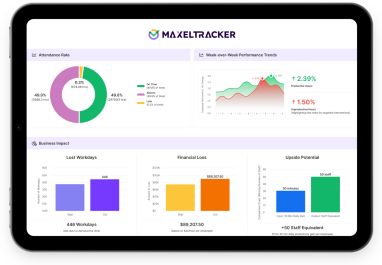
MaxelTracker efficiently fills the operational gaps that most remote setups in your organization struggle with. It gives your leaders real-time visibility into how work happens on the floor. You can easily track active time, idle time, app and website usage, attendance management, progress, and actual output. This eliminates any and all blind spots, reduces dependency on opinions, and replaces guesswork with actual verifiable data. At the same time, its privacy-respecting tracking and screen monitoring restore accountability. This prevents your company culture from being damaged.
Teams can focus and know their boundaries, while your leaders get clarity and control.
The outcome is a remote environment that runs with discipline, predictability, and significantly lower friction. Global teams stay aligned, distractions drop, and performance becomes more consistent.
👉 Sign up now at maxeltracker.com and start transforming your team’s productivity today! 🚀
👉 Explore our pricing plans and features to find the perfect solution for your team’s productivity needs! 🚀