MaxelTracker

MaxelTracker
Know exactly where your team's time goes. MaxelTracker gives managers clear, real-time visibility into team productivity — no spreadsheets, no guesswork. Built for businesses of every size.

Written by
Rowan Hale
The traditional "office" as we once knew it has undergone a radical change. Gone are the days of rows of boring cubicles and the hum of industrial-grade coffee machines. Today, the modern workplace that we see and work in is a patchwork of functional living rooms. There are co-working spaces and kitchen tables scattered across different time zones as well. Remote and hybrid work is no longer a perk; it has, in fact, become fundamental to how modern businesses operate. Have you ever wondered how much this shift has truly altered your bottom line?
However, as the physical walls of your office come down, new digital barriers go up right before you. While flexibility has undoubtedly improved employee retention, it has introduced a silent killer of sorts, of your growth. This is called the productivity gap. In fact, research from Gallup suggests that while remote workers are often highly engaged, they frequently face an "eroding connection" to company culture and clarity—a recipe for declining output. This is so right, as a disconnected team is rarely a high-performing one.
Traditional supervision is officially dead. In this new era, businesses all over the world are gradually realizing that manual check-in is not going to be enough. To thrive, leadership must pivot toward smarter digital systems that provide real-time visibility into how work is actually unfolding. Think about it seriously: can you really afford to manage in the dark?
Managing a team you cannot see is, quite frankly, an executive’s nightmare. For a CEO or COO, for instance, the transition to remote work often feels like flying a plane through a thick fog without any instruments or any passengers, to be honest. You know the engines are running, but you have no idea if you’re gaining altitude or headed for a mountain. No business will be willing to take that risk for long. The core challenges are systemic:
The Visibility Void: Without a shared physical space, daily work activities disappear into a black box. Is it weird? Perhaps, but it is the current reality.
The Effort vs. Output Delusion: In a remote work setting, your "effort" is often measured by how quickly someone responds to a chat message, rather than the quality of the work they produced. You feel that you have achieved a deadline upon just getting a response.
The Fragmentation of Time: As your work bleeds into life, time gets dispersed into a thousand-piece puzzle of random emails, tiny and extensive chores, and "quick syncs." Bitter but true.
Without structured systems, the demand for data-driven workforce decision-making has moved from a "nice-to-have" to a survival requirement for the C-suite. This is the need of the hour.
Productivity drops in remote settings are rarely due to a lack of talent. Most employees want to work well; they just lack the architecture to do so. According to insights often shared by the Forbes Councils, over 70% of executives view the "visibility gap" as a primary risk to operational accountability. Something tells me that this number will only grow as the market gets more competitive.
When a manager cannot see task-level progress, they default to "management by hovering" or "management by hoping." Neither works. Without clear visibility, work distribution becomes skewed. One "star" employee might be drowning while another is unintentionally idling, simply because gaps in the workflow remain unnoticed. To be exact, without data, you are just guessing.
The lack of a structured environment at work translates into your employees often struggling with task prioritization and failed time management. Their focus time is the first casualty of a typical remote work setup. Frequent context switching which includes jumping from a deep-focus task to a "ping" on a messaging app is often distracting and frustrating. It can reduce their cognitive productivity by up to 40% and also eats into their time. So keep in mind that your team’s focus is your most valuable currency.
If you can’t measure it, you can’t improve it. Many teams operate without measurable performance indicators. They don’t know their peak performance hours, nor do they have clarity on which workflows are bogged down by administrative "red tape." Don’t you want to know where the bottlenecks really are?
Remote accountability can be "fuzzy." When a deadline is missed in an office, you can see the bottleneck. In a remote work setup, many bottlenecks are often identified only when it’s too late. This forces the upper and mid-level management to enter into a reactive and corrective mode that often sucks valuable time. This is so risky, and you would agree that reactive management is expensive.
Ironically, to compensate for not seeing each other that often, remote teams often over-communicate. We’ve all been there and know how a 30-minute meeting to discuss why a 10-minute task isn't done turns into an hour-long discussion. This "reporting on the work" often takes more time than the actual task execution. Hasn’t it ever gotten you curious as to how much time is wasted just talking about work?
For the CFO, low productivity isn't just a morale issue; it’s a line item that is bleeding the company dry. So what do you think? Is it time to reassess the strategy?
Operational Costs: Unmanaged time is essentially capital being set on fire.
Lower Efficiency per Employee: If your "cost per unit of output" is rising, your margins are shrinking. And of course, this impacts the bottom line directly.
Scaling Friction: You cannot scale a mess. If you don't know why your current team is struggling, adding more people will only double your problems.
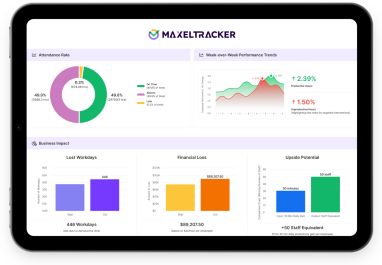
The answer isn't to force everyone back to a 1950s cubicle—it’s to upgrade the tech stack. Leadership is increasingly adopting productivity tracking software to bridge the distance. Of course, these tools aren't about "spying"; they are about converting abstract activity into meaningful business intelligence. And that is exactly what it does. By using remote employee productivity tracking, your managers gain a high-definition view of the team’s actual health. It allows your leadership to stop asking "What are you doing?" and start asking "How can I help you finish this faster?"
The most effective way to restore productivity is to introduce transparency.
Live screen monitoring software: This provides the context that is missing in a remote environment. And also make sure you are using this context to coach, not just critique.
Idle time tracking: This is a crucial metric for understanding engagement. It’s not about counting every coffee break; it’s about identifying patterns. Well, it is not unknown to be honest, that high idle time often points to poor tool integration rather than lazy staff.
Location tracking software: Essential for hybrid teams or those with field-based components, ensuring that resources are positioned where they are most effective.
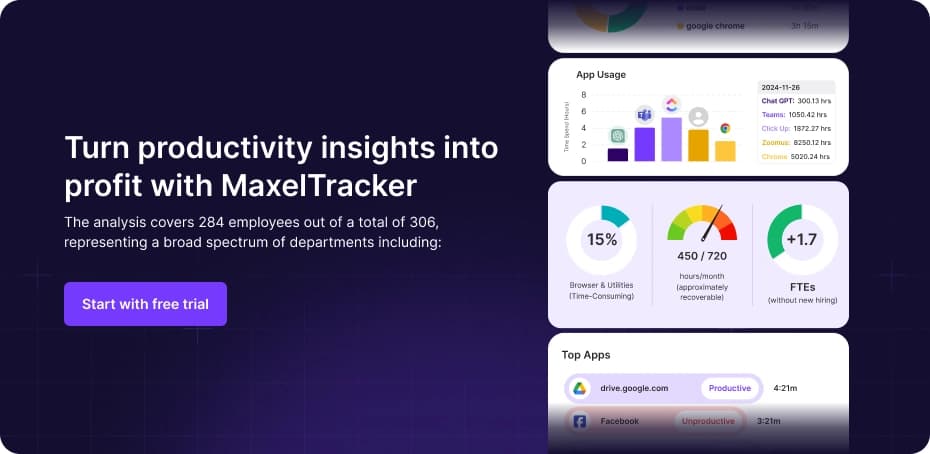
There is a psychological shift that happens when work is measurable. Clear visibility naturally improves employee efficiency. You would agree that people perform better when the score is being kept. When an employee knows their progress is visible through a system like MaxelTracker, the temptation to procrastinate diminishes. And yes, this gives the manager the ability to identify a delay before it escalates.
For HR leaders, a data-driven culture is the ultimate defense against burnout. The Harvard Business Review notes that "transparency paradox" research shows teams perform better when they have clear, data-driven boundaries rather than vague, "trust-based" systems. You just have to agree with me on this one: clarity is kindness. By using productivity data, HR can:
Identify over-performers who need a break.
Set realistic expectations based on actual work behavior.
Support employees with structure, which actually increases job satisfaction by reducing ambiguity. But remember, data is a tool for support, not just a yardstick.
This is where a solution like MaxelTracker enters the conversation. Exactly what it is meant to do is unify time tracking, productivity monitoring, and reporting into a single source of truth. So yes, it replaces the guesswork with precision.
For a CTO, having productivity tracking software that provides task-level insights means they can ensure the engineering team isn't wasting 4 hours a day on administrative "noise." Give it more than just a thought, I’ll say: your competitors are doing it right now.
When you move from manual supervision to a system like MaxelTracker, the benefits are immediate:
Consistency: Output remains steady regardless of where the team is sitting.
Predictability: Better data leads to better project forecasting. Be sure to do that before your next quarterly board meeting.
Reduced Idle Time: Idle time tracking allows you to trim away efforts and actions that often bring redundancy and unwanted wait periods/pauses in your operational workflows.
Alignment: When everyone can see the goalposts, they are more likely to kick in the right direction. This is absolutely necessary for growth.
Remote productivity challenges are not a "people problem"—they are a "system problem." You cannot expect 2026 results using 1996 management techniques. Don’t be crazy, they would say if you tried to run a modern cloud business on a ledger book. Without remote employee productivity tracking, you aren't managing a company; you're just hoping for the best.
Remember this: when organizations begin introducing structured tracking and visibility systems like MaxelTracker—incorporating live screen monitoring software, location tracking software, and idle time tracking—they stop micromanaging automatically. They stop going by their assumption and start managing by evidence. What do you think? Is your business ready for total visibility? Better visibility leads to better productivity at work, stronger accountability, and ultimately, a business that can scale infinitely. Don’t forget to do the research and find the system that fits your needs. It’s time to turn the lights on in the remote office.
Related Blogs
Time management: Definition, benefits, process, techniques, and challenges
Time management is the process of planning, organizing, and controlling time in order to improve efficiency, effectiveness, and productivity.

What is time budgeting and how to budget your time effectively?
Time budgeting is the practice of intentionally allocating time to activities and tasks one needs to do in a day, week, month, or over a set period. It treats time like money.
What Are The 4 P’s in Time Management?
Struggling with time management? You’re not alone. Many of us face challenges when it comes to staying focused, prioritizing tasks, and working efficiently.